 If you’ve ever sent a recruiting email only to watch it bounce, you know how fast coaching staff information goes stale. Assistants get promoted. Coordinators change schools. Universities migrate to new email systems overnight.
That’s why we update our entire college coaching database every single month — and the February 2026 cycle was one of our most comprehensive updates to date.
Here’s exactly what changed and why it matters for your recruiting outreach.
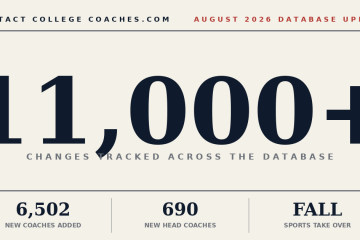
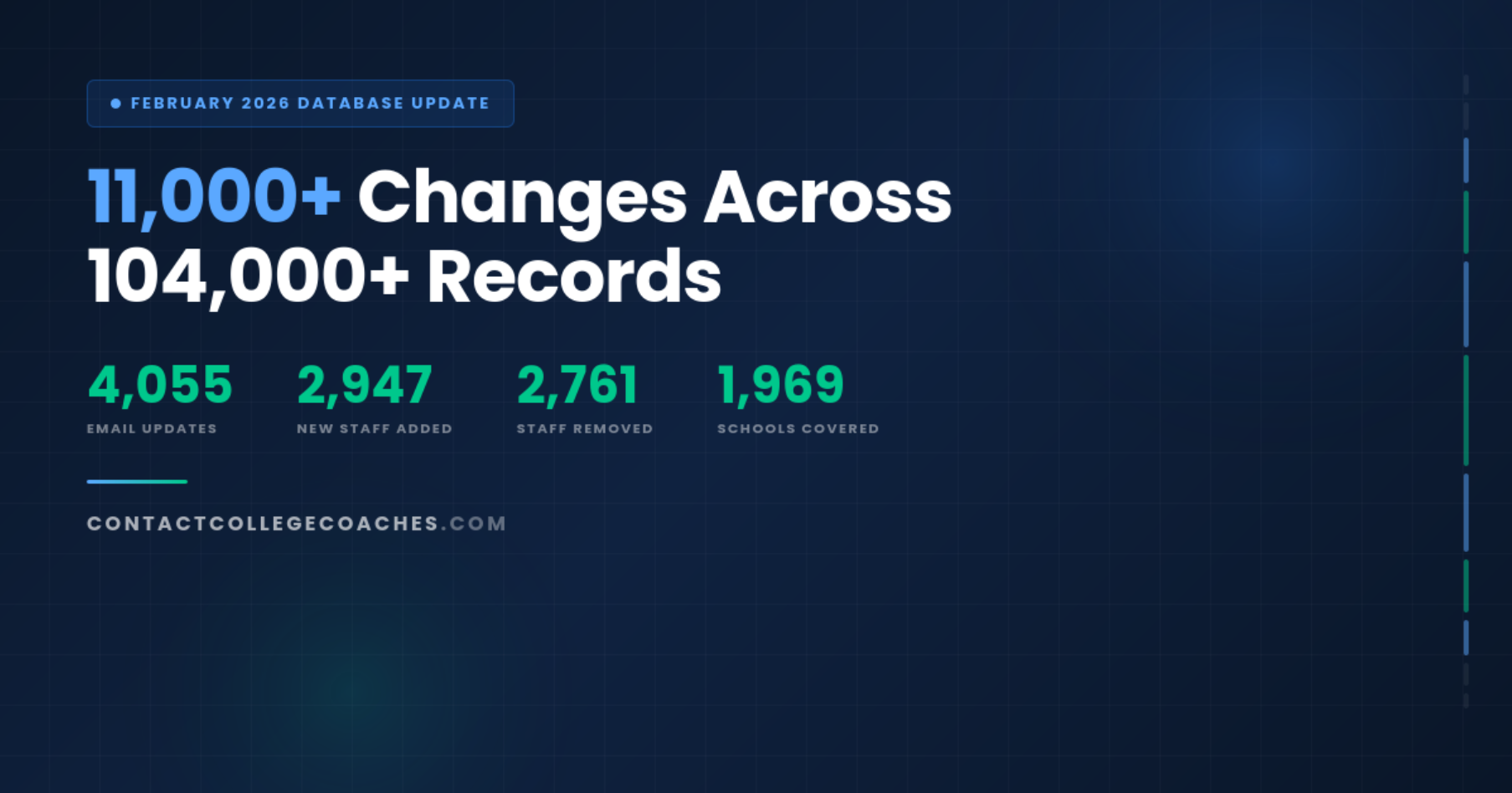
By the Numbers: 11,200+ Individual Changes
This month, we processed 11,200+ individual changes across our database of 104,612 coaching staff records spanning 1,969 schools, 43 sports, and every competitive division level in college athletics — NCAA Division I, II, and III, NAIA, NJCAA, CCCAA, and NWAC.
Roughly 1 in 10 records in the entire database was touched during this update cycle. Here’s the breakdown:
4,055 email address updates — The single largest category of changes this month, and it’s not even close. Whether it’s a coach moving from a personal to an institutional address, a recently-added address or a domain change following a university rebrand, outdated email addresses are the number-one reason recruiting messages never reach a coach’s inbox. We updated over four thousand of them.
2,947 new staff additions — Nearly three thousand new coaching staff members were identified and added across all sports and divisions. That includes new head coaches, newly hired assistants, freshly created support staff positions, and coordinators who arrived mid-year.
2,761 staff removals — Coaches who left their positions — whether through retirement, termination, or a move to another program — were flagged and removed so your outreach doesn’t land in a dead inbox.
1,004 job title updates — Title changes are more common than most families realize. An “assistant coach” becomes a “recruiting coordinator.” A “quarterbacks coach” is promoted to “offensive coordinator.” An “assistant coach” becomes a “head coach.” We track these shifts because the right title helps you address the right person.
347 phone number updates — Direct lines change when staff move offices, switch extensions, or transition to new phone systems.
56 name updates and 32 conference reassignments — Smaller in volume, but just as important for accuracy.
Email Updates: Why 4,000+ Changes Should Get Your Attention
Let’s put the email number in perspective. When we built out our initial coaching records, not every staff member had a publicly listed email address. Some school directories only displayed a general athletics department contact. Others listed phone numbers but no email. In many cases, we had a coach’s name, title, and school — but no direct email to go with it.
This month, we made a concerted effort to close that gap. Our data team went school by school, checked each institution’s online staff directory, and sourced individual email addresses for coaches and staff members who previously had no email listed in our database. That manual, directory-level research is how the large majority of these 4,000+ email updates happened — and it’s the kind of work that makes a measurable difference in your outreach. A coaching record with a name and phone number is useful. A coaching record with a verified, direct email address is what actually gets your message in front of the right person.
Here’s how email updates broke down by division:
- NCAA Division III led with 1,416 email changes — the largest volume of any division, reflecting the sheer size of DIII and the number of smaller programs whose staff directories we had not yet fully sourced.
- NCAA Division I saw 701 email updates across its non-football programs, plus an additional 95 at the FBS level and 56 at the FCS level.
- NCAA Division II had 647 email updates.
- NAIA programs required 488 updates.
- Junior college programs (NJCAA, CCCAA, and NWAC combined) totaled 408 email updates.
The takeaway? Email gaps exist at every level. Whether you’re targeting Power Four programs or small-college opportunities, the completeness of your contact data directly impacts how many coaches you can actually reach — and a data team willing to dig through directories school by school is the difference between a list with holes and one without.
Something No Other Coaching Database Offers: Full School-Level Academic Data
Most coaching contact databases give you names, emails, and phone numbers. That’s it. Finding out whether a school fits your academic profile, budget, or location preferences means opening a dozen browser tabs and cross-referencing everything manually.
We’ve always included school-level data alongside our coaching contacts, but this month we completed a comprehensive refresh of that information for all 1,969 schools — the first time much of it has been updated in multiple years because of the scale of the project. We went back to primary federal and institutional sources — IPEDS/NCES, the U.S. News & World Report rankings, and each school’s own website — and verified or updated every field.
Here’s what’s included with every coaching record in our database, and what no competitor provides:
- City, state, and regional classifications for every institution
- City population size — so you can filter by small-town, mid-size, or metro programs
- Public/private status and religious affiliations
- HBCU, community college, and women’s college designations
- Average SAT-Reading, SAT-Math ACT score ranges (25th–75th percentile)
- Acceptance rates and total-yearly cost (tuition, room and board, books/supplies — broken out by in-state and out-of-state)
- Number of undergraduates and direct links to each school’s majors page
- 2026 U.S. News rankings (both National University and National Liberal Arts College categories)
- IPEDS/NCES institutional ID numbers for every school
This is a genuine differentiator. Recruiting isn’t just about finding the right coach and program — it’s about finding the right school. A family whose student-athlete needs a nursing program at a mid-size private school in the Southeast with an acceptance rate above 50% can now filter for exactly that and see every relevant coaching contact in one view. No other coaching contact service lets you do this.
Sport-by-Sport: Where the Biggest Changes Happened
College football dominated the change log, as it does every February. The combination of coaching carousel season, national signing day staff buildouts, and coordinator shuffles produced 1,844 total changes in football alone — including 915 new staff additions and 546 job title updates.
Here’s how the top sports stacked up:
- Football — 1,844 changes (915 new, 408 email, 546 title)
- Baseball — 665 changes
- Softball — 501 changes
- Women’s Track & Field — 476 changes
- Men’s Track & Field — 470 changes
- Men’s Basketball — 424 changes (285 email updates, 101 new staff)
- Women’s Volleyball — 416 changes
- Women’s Soccer — 414 changes
- Men’s Soccer — 369 changes
- Women’s Basketball — 306 changes (242 email updates, 40 new staff)
One pattern worth noting: basketball programs leaned heavily toward email updates rather than new hires in this cycle, which makes sense — the season was still underway in March when the data was compiled, so most staffs were locked in. Football, by contrast, saw the bulk of its changes come from new hires and title changes — exactly what you’d expect during coaching carousel season. Expect basketball to follow the same pattern in the months ahead. Now that the 2025-26 college basketball season has ended and the transfer portal has opened, coaching turnover is accelerating fast. The April, May, and June updates will reflect a surge of new hires, departures, and staff overhauls across men’s and women’s basketball at every division level — and if the 28 new Division I men’s basketball head coaches we’ve already tracked are any indication, those numbers are going to be significant.
What This Means for Your Recruiting
Every bounced email is a missed opportunity. Every message addressed to a coach who left three months ago is wasted effort — or worse, it signals to the new staff that you haven’t done your homework.
Our database covers 43 sports across every competitive division level in college athletics, and we verify every record monthly. That’s not a marketing claim — the 11,200+ changes above are the proof.
If you’re a high school athlete building your target list, a club coach helping your players get recruited, or a recruiting consultant managing outreach at scale, accurate data is the foundation everything else is built on.
Browse our coaching databases by sport →
ContactCollegeCoaches.com updates its coaching contact databases every month. Each sport and division combination is available as a standalone subscription. Questions? Reach out to us anytime.